Pancreatic Cancer: Symptoms, Diagnosis and Treatment
If pancreatic cancer has touched your life — or the life of someone you love — this page was written for you. Together, we will walk through what it is, the signs to watch for, how it is diagnosed and staged, whether it can be operated on, and how it is treated here at Dhaara Speciality Hospital, Yelahanka, by Dr. Srinivas Bojanapu, Surgical Gastroenterologist & HPB Surgeon.
Medically reviewed by Dr. Srinivas Bojanapu · September 2026
Pancreatic cancer in 30 seconds
- What it is: cancer that begins in the pancreas — a quiet, hard-working gland hidden deep behind your stomach, which helps you digest food and keeps your blood sugar steady.
- Why it matters: in its early stages it often says nothing at all, and in India most cases are found late — which is why the warning signs matter so much.
- Key symptoms: painless jaundice, unexplained weight loss, upper-abdominal pain radiating to the back, new-onset diabetes after 50, pale greasy stools with dark urine.
- If you are worried: most people with these symptoms do not have pancreatic cancer. But if you recognise them in yourself, they always deserve a proper, unhurried review.
- Good news: treatment is active at every stage — surgery (the Whipple procedure) when the disease is removable, chemotherapy before, after or instead of surgery.
If you or a family member has just been diagnosed
Take a breath. This is a great deal to absorb in one sitting — and you do not have to absorb it all at once. These are the questions nearly every family asks first, with honest, short answers:
None of these answers is a verdict on its own. Staging decides the plan — and plans have options.
First, the pancreas: where it is and what it does
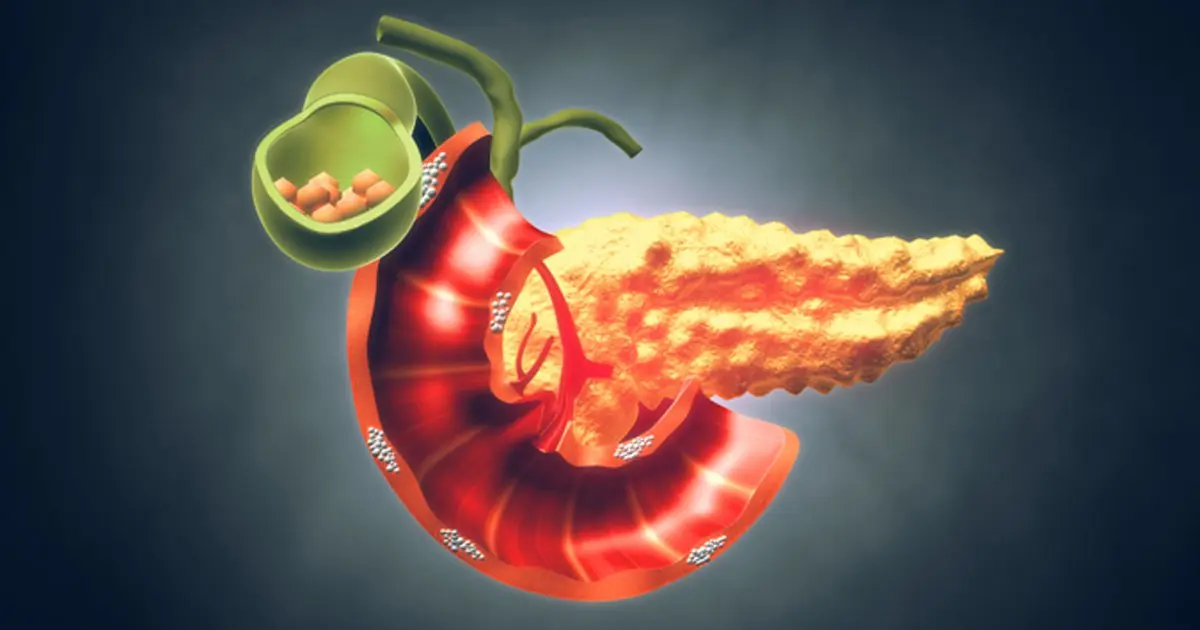
Let's meet the pancreas. It is a soft, pale gland about 15 cm long, hidden deep behind your stomach. Its broad right end — the head — is cradled by the duodenum, the first part of your small intestine. The middle is the body. And the slender left end — the tail — reaches quietly towards the spleen.
It is one of the body's most elegant two-in-one designs: a factory that pours digestive enzymes into your gut to break down the fat and protein on your plate, and a laboratory that doses insulin and glucagon into your blood to keep your sugar steady. Because it hides so deep and works so silently, trouble here often goes unnoticed. That, in a sentence, is why this disease is often found late — and why understanding this little organ helps everything else on this page make sense.
What is pancreatic cancer?
So what has gone wrong? Your cells normally grow only on instruction. In cancer, that control system fails: cells in the pancreas begin to multiply beyond instruction and slowly form a tumour. About 9 in 10 are pancreatic ductal adenocarcinoma, arising from the enzyme-producing ducts. A smaller number begin in the hormone-producing cells — pancreatic neuroendocrine tumours — which behave differently, are treated differently, and often carry a better outlook.
As a tumour grows, it can block the bile duct — that is what causes jaundice — or wrap itself around the great blood vessels behind the pancreas, or travel onwards to organs such as the liver. Blockage, invasion, spread: these are the three directions in which this disease does its harm, and staging scans measure each of them. That is why the scans sit at the very heart of planning your treatment.
Symptoms of pancreatic cancer
In its early stages, this disease often says nothing at all. And when it does speak, the first whispers are vague — easily blamed on commoner troubles. The groups below show how the symptoms typically surface.
Most common
- Painless jaundice — yellowing of eyes and skin without pain, sometimes with itching
- Unexplained weight loss and loss of appetite
- Upper-abdominal pain boring through to the back
- New-onset diabetes after age 50
Also worth knowing
- Pale, greasy, floating stools with dark urine (blocked bile flow)
- Nausea, or fullness after a few bites
- Fatigue and weakness
Can appear later
- Back pain worse when lying flat
- Vomiting
- Sudden worsening of long-standing diabetes
Easily confused with
- Acidity or gastritis
- Gallstones
- Pancreatitis (see our pancreatitis page)
- Simple back strain — or "just ageing"
Several of these symptoms share a single mechanism: when the bile duct is blocked, bile backs up — yellowing the eyes, darkening the urine and itching the skin. Knowing that one fact makes the list far less mysterious.
Please hold on to this: having one or more of these symptoms does not mean you have pancreatic cancer — most people with them do not. But a combination, or anything that lingers beyond a couple of weeks, deserves a proper review. And the reverse is equally true: an absence of symptoms does not rule the disease out.
When should you see a doctor?
Most of these symptoms turn out to have simple, ordinary causes. All the tiers below do is help you judge how quickly to seek a review — calmly, and without alarm.
review
Next available appointment: indigestion not responding to usual treatment; appetite loss with tiredness; new diabetes after 50 — mention the pancreas specifically.
(days)
Within days, not weeks: unexplained weight loss with any symptom above; upper-abdominal pain to the back persisting beyond two weeks; pale greasy stools; diabetes suddenly hard to control.
(same day)
Do not wait: painless jaundice; jaundice with fever and chills; severe uncontrolled pain; vomiting that prevents keeping fluids down. Call 87478 74666 — Dhaara runs a 24/7 emergency service.
Causes and risk factors — and why they are not the same
A cause directly produces a disease; a risk factor only shifts its probability — think of it as loading dice: it changes the odds, never any single outcome for certain. And for most people who develop pancreatic cancer, no single cause can be found. It is nobody's fault — not yours, and not your family's. A diagnosis is not a verdict on how anyone lived.
- Smoking — the strongest modifiable risk factor
- Chronic pancreatitis, particularly hereditary pancreatitis
- Long-standing diabetes, especially type 2 of many years
- Obesity and physical inactivity
- Age — most people diagnosed are over 60
- Family history of pancreatic cancer and inherited gene changes (such as BRCA2)
- Heavy alcohol use, mainly via chronic pancreatitis
A risk factor is not a destiny. Many people with risk factors never develop the disease, and many who do have none of these at all. If your family history concerns you, tell us at consultation — a surveillance plan can be discussed.
"I have a pancreatic mass" — does it mean cancer?
No — it does not. And here is the first steadying fact. A "mass" means your scan has found something abnormal — a question that needs answering, not a diagnosis in itself. Scans can show that something is there, its size, and where it sits. On their own, they cannot tell you what it is.
Several quite different conditions can produce a pancreatic mass — which is precisely why specialists study its features so carefully before concluding anything:
- A pseudocyst — a fluid collection following pancreatitis
- An inflammatory mass in chronic pancreatitis
- Cystic neoplasms (such as IPMN) — some need surgery, some only monitoring
- A neuroendocrine tumour — a different type with different treatment
- Autoimmune pancreatitis — mimics cancer, responds to medication
A specialised CT, an endoscopic ultrasound and — where needed — a biopsy will establish what it truly is. Whatever it proves to be, a pancreatic mass always deserves specialist review. The cost of waiting is far higher than the cost of checking.
How is pancreatic cancer diagnosed? A step-by-step journey
You will not need every test — the sequence is tailored to you. But it usually follows this order:
- Clinical assessment. It begins with a conversation — your history, and an examination. This raises or lowers suspicion; on its own, it cannot confirm or exclude the disease.
- Blood tests. Liver function tests show whether bile flow is blocked. CA 19-9 supports diagnosis and monitors treatment — it is not a screening test, can rise for benign reasons, and never proves cancer by itself.
- Pancreas-protocol CT. The cornerstone of everything that follows. Here is what this scan actually measures: the tumour's reach — and the distance between it and the great blood vessels. That distance, more than anything else on the scan, decides whether surgery is possible. A routine CT is not a substitute.
- EUS and tissue sampling. Endoscopic ultrasound uses sound waves to paint a picture from just millimetres away — close enough to guide a needle biopsy. And if the bile duct is blocked, a stent can be placed to relieve jaundice before treatment.
- Staging review. Scans are read together to map whether disease remains confined or involves vessels or other organs.
- Multidisciplinary planning. Before anything begins, your surgeon, oncologist, radiologist and pathologist sit down together and agree on one plan — yours.
Staging, in plain language
Strip away the medical vocabulary, and staging answers three simple questions: Is it removable with surgery? Does it touch the great vessels? Has it travelled?
| Stage | What it means | Typical approach |
|---|---|---|
| Resectable | Tumour confined to the pancreas, clearly away from the major vessels — it appears removable with surgery | Surgery (typically the Whipple procedure) is usually the first treatment |
| Borderline resectable | Tumour touching, but not engulfing, the major vessels — surgery may still be possible | Chemotherapy often given first; surgery may follow if the tumour responds |
| Locally advanced | Tumour wrapped around major vessels, with no spread elsewhere | Usually chemotherapy first, sometimes with radiation; surgery only in selected cases after review |
| Metastatic | Cancer has spread to other organs, most often the liver | Drug treatment (chemotherapy and other medicines) with strong supportive and palliative care |
These terms describe findings on staging scans. The final plan is always individualised after multidisciplinary review — treat this table as general information, not as your plan.
"Can it be operated?" — the question patients ask first
Now we come to the question nearly everyone asks first — and it deserves a straight answer. There are three honest ones, and all three are active paths:
1. Yes — surgery first. Tumour confined, clear of the major vessels, patient fit: an operation (usually the Whipple procedure) is typically the first treatment.
2. Possibly — after chemotherapy. When the tumour only touches the vessels, chemotherapy given first can shrink it enough to make surgery possible. Modern protocols have changed what is operable — often remarkably.
3. Surgery is not the path — treatment is. When vessels are engulfed or disease has spread, surgery would not help; chemotherapy, sometimes with radiation, plus strong supportive care becomes the mainstay. "No operation" does not mean "no treatment".
What decides: where the tumour sits (head → Whipple; body/tail → distal pancreatectomy), vessel involvement, spread and fitness. If chemotherapy is advised first, that is a deliberate strategy — not a setback.
Treatment options for pancreatic cancer
The treatment plan depends mainly on the stage and whether the cancer can be safely removed. Surgery is used when removal is possible, while drug treatment is used at many stages and may be combined with other treatments.
Surgery
What: removing the tumour — the Whipple procedure for head tumours, distal pancreatectomy for body/tail. Why: the only treatment that removes the disease entirely, offering the best chance of long-term control. When: resectable disease (or borderline converted by chemotherapy first) in a fit patient. Limitations: needs early-stage disease and an experienced surgical team. Risks: pancreatic leak, delayed stomach emptying, infection, bleeding; 7–10 days in hospital, 6–8 weeks to full recovery.
Chemotherapy
What: medicines that stop cancer cells dividing, given as day-care infusions. Why: before surgery (improving operability), after surgery (reducing recurrence), or as main treatment for advanced disease. When: every stage. Limitations: complements — not replaces — surgery when surgery is possible. Risks: fatigue, nausea (well controlled today), lower blood counts; day-care chemotherapy support is available at Dhaara.
Radiotherapy
What: high-energy beams targeted at the tumour. Why/when: selectively — some locally advanced or borderline tumours, or symptom control. Limitations: a narrower role in pancreatic cancer than in many cancers; decided case by case. Risks: fatigue, temporary digestive irritation.
Targeted therapy and immunotherapy
What: drugs acting on specific genetic changes in the tumour, or helping the immune system recognise it. Why/when: only for selected patients whose tumour carries particular molecular findings — genetic testing is sometimes advised. Limitations: applies to a minority; not standard for most. Risks: vary by drug; the oncologist explains them for the specific medicine.
Supportive and palliative care
What: care focused on symptoms, comfort and daily function. Why: pain, jaundice, digestion, diabetes and nutrition affect quality of life as much as the disease. When: from day one, alongside every treatment — it is not "giving up". Our Pain & Palliative Care team and dieticians work with families throughout.
The Whipple procedure, explained
The standard operation for tumours of the head of the pancreas carries a name that sounds formidable. Let's make it less so. Our dedicated Whipple page goes deeper.
What happens after diagnosis — the usual pathway
- Suspicion raised — symptoms, blood tests or a scan done elsewhere
- Confirm and characterise — pancreas-protocol CT, EUS, biopsy where appropriate
- Establish stage and operability — vessels and spread mapped
- Multidisciplinary review — the team agrees one plan
- Treatment — surgery and/or chemotherapy, in the order your stage requires
- Support throughout — nutrition, diabetes and symptom care alongside
- Recovery and adjuvant therapy — chemotherapy after surgery where indicated
- Surveillance — regular reviews, blood tests (including CA 19-9) and periodic scans
Your details may differ; the order rarely does. And should the disease return later, options still exist — a recurrence changes the plan; it does not end care.
What is the outlook (prognosis)?
Now let us be honest with each other, because you deserve nothing less. This is a serious disease. But an outcome is not a single number — it rests on things we can name:
- Stage at diagnosis — whether the tumour is still removable
- Vessel involvement and whether disease has spread
- Fitness and nutrition — they shape which treatments are possible
- Tumour biology — how it responds to chemotherapy
- Completeness of surgery where done, and access to modern therapy
For context — and only ever as context — US population data (SEER, 2015–2021) puts five-year survival at roughly 13% across all stages combined, and substantially higher when the disease is found while still removable. A number like that is not a prophecy: it is an average computed over an entire population — and you are not a population. Your own outlook rests on the factors above, and it is best discussed with your treating team, face to face. No one can promise an outcome. No one should try.
Nutrition and daily life
Digestion and pancreatic enzymes
Loose, greasy stools are common — your pancreas makes the enzymes that digest fat, and treatment can slow that work. Pancreatic enzyme tablets taken with meals genuinely help. If stools stay greasy, tell your team; adjusting the dose is routine, and easily done.
Blood sugar and diabetes
Diabetes may appear or become harder to control through treatment. Active monitoring matters, and insulin is sometimes needed temporarily — blood-sugar care is part of pancreatic care, not a separate problem.
Appetite and weight
Small, frequent meals usually beat three large ones. Our dieticians build an individual plan and adjust it as treatment changes — weight is checked at every review.
Activity and daily living
Gentle daily walking helps recovery, appetite and mood more than most people expect. Pace your return to work with your team — and bring a family member to consultations. Two sets of ears absorb far more than one.
Questions to ask your doctor
Before the appointment: bring all scan films/CDs (the imaging itself, not just reports), blood results, your medication list — and a family member.
- What exactly is my diagnosis — which type of pancreatic cancer?
- What stage is it — resectable, borderline, locally advanced or metastatic?
- Has it spread beyond the pancreas?
- Is surgery possible in my case — now, or after other treatment?
- Do I need a biopsy before treatment decisions?
- Should chemotherapy start before surgery in my situation?
- Am I a candidate for the Whipple procedure — and what are my specific risks?
- Who will be involved in my care — and who do I contact between appointments?
- If surgery is not possible, what are my options — and what is the goal of each?
- Do I need genetic testing, and what nutrition/diabetes support is available?
If you would like more confidence about your diagnosis or treatment plan, seeking a second opinion is reasonable.
Frequently Asked Questions
Is pancreatic cancer always fatal?
No. Early-stage disease that has been removed by surgery, followed by adjuvant therapy (treatment given after surgery), gives meaningful long-term survival — and modern chemotherapy has materially improved outcomes even in advanced stages. This disease rewards promptness, which is why painless jaundice is treated as urgent.
What is the Whipple procedure?
Pancreaticoduodenectomy: removal of the pancreatic head, duodenum, bile duct and gallbladder with reconstruction — a 6–8 hour operation best done by surgeons and teams who perform it regularly. Outcomes track strongly with centre volume.
Can surgery be done if the vessel is involved?
Borderline-resectable tumours touching major vessels are often converted to operable with neoadjuvant chemotherapy (treatment given before surgery) — modern protocols have changed what is possible. Vascular resection is an option in selected experienced centres.
Why does pancreatic cancer cause diabetes?
The pancreas produces insulin; tumours destroying pancreatic tissue impair insulin production. New-onset diabetes after 50, especially with weight loss, is a recognised early flag — worth a pancreatic evaluation, not just a sugar tablet.
What does recovery after Whipple surgery look like?
Hospital stay of 7–10 days with monitored diet progression; full recovery over 6–8 weeks. Pancreatic enzyme tablets and sometimes diabetes treatment continue. Nutrition recovery is the marathon — our dieticians stay with you through it.
Does a pancreatic mass always mean cancer?
No. Pancreatic masses can also be pseudocysts after pancreatitis, inflammatory masses in chronic pancreatitis, cystic neoplasms, neuroendocrine tumours or autoimmune pancreatitis. A specialised CT, endoscopic ultrasound and — where needed — biopsy establish what a mass actually is. Every pancreatic mass deserves specialist review either way.
Can pancreatic cancer be prevented?
There is no guaranteed way to prevent pancreatic cancer. Not smoking, keeping a healthy weight, limiting alcohol and controlling diabetes lower overall risk. People with a strong family history or known inherited gene changes such as BRCA2 should discuss a personalised surveillance plan with a specialist — there is no routine screening test for average-risk individuals.
How Dhaara Speciality Hospital can help
And if you need us, here is what stands ready for you under one roof in Yelahanka, Bangalore:
- Surgical opinion and pancreatic surgery — led by Dr. Srinivas Bojanapu (MBBS, MS, FACRSI, DrNB, PDF), Surgical Gastroenterologist & HPB Surgeon
- Pancreas-protocol CT, MRI/MRCP and ultrasound — see facilities
- Endoscopic ultrasound — detailed imaging of the bile duct and pancreas
- Whipple and other pancreatic operations — with intensive-care backup, see critical care
- Day-care chemotherapy support — see day-care services
- Pain & Palliative Care team and dieticians — see pain & palliative care
- 24/7 emergency and critical care

Dr. Srinivas Bojanapu
MBBS, MS, FACRSI, DrNB, PDF — Surgical Gastroenterologist & HPB Surgeon with 16+ years of experience and 5,000+ procedures, including complex pancreatic and hepatobiliary operations.
Medically reviewed by Dr. Srinivas Bojanapu — MBBS, MS, FACRSI, DrNB, PDF · Surgical Gastroenterologist & HPB Surgeon · Last updated: September 2026.
This page provides general information about pancreatic cancer and is not a substitute for personal medical advice, diagnosis or treatment. Treatment decisions are always individualised after clinical assessment.
Sources & standards:
- GLOBOCAN 2022 — Global Cancer Observatory, International Agency for Research on Cancer (IARC), Lyon (worldwide incidence estimate).
- SEER Program (National Cancer Institute, USA) — Cancer Stat Facts: Pancreatic Cancer, five-year relative survival, 2015–2021 (population statistic, context only).
- Management follows internationally accepted guidelines, including NCCN and ASCO clinical practice guidance.
- Institutional figures on this page (patients treated, surgical experience) are based on Dhaara Hospital records.
Book a Surgical Opinion
Have scans or a diagnosis in hand? Discuss staging and surgical options with Dr. Srinivas Bojanapu at Dhaara Speciality Hospital, Yelahanka.
Words From Our Happy Clients
Glowing testimonials from satisfied clients share their positive experiences.
Dhaara Speciality Hospital is a trusted healthcare institution equipped with state-of-the-art facilities and a team of skilled surgeons, including specialists in laparoscopic procedures. Choosing Dhaara for your laparoscopic gallbladder surgery comes with several advantages.
More Reviews
Vinay T
India
Surprised at the excellent facilities
I visited Dhaara Hospital and consulted with Dr. Prathima, a fantastic gynecologist. She's professional, friendly, and listens to my concerns. Her treatment worked well for me, and she always suggests the best.
Suchetha
India
Surprised at the excellent facilities
Dr Sreenivas is brilliant. The way, he listens to the patients issue giving so much time inspite of his busy schedule. I am very happy to have met him for my mom's surgery. Best Gastro surgeon👏👏.

.webp)
.webp)