Expert laparoscopic (keyhole) hysterectomy by Dr. Prathima Srinivas in Yelahanka. Minimal pain, 2-day stay, faster recovery than open surgery. Fibroids, uterine cancer, prolapse.
10,000+
Patients Treated
15+ Years
Surgical Experience
24/7
Emergency Care
Key Takeaways
- Laparoscopic hysterectomy removes the uterus through 3–4 tiny 'keyhole' cuts instead of one large incision.
- Typical stay is 1–2 days versus 4–5 for open surgery; most women resume desk work in 2–3 weeks.
- Done by Dr. Prathima Srinivas, an experienced gynae-laparoscopic surgeon.
- Ovaries are preserved when healthy — discuss hormone protection before surgery.
When is a Hysterectomy the Right Choice?
Hysterectomy (removal of the uterus) is considered when symptoms are severe and other treatments have failed or are inappropriate:
- Fibroids causing heavy bleeding, pain or pressure unrelieved by medicines/surgery
- Adenomyosis with disabling periods
- Endometriosis, repeated cyst problems, or chronic pelvic pain in selected cases
- Suspected or confirmed uterine cancer, or high-grade pre-cancerous change
Keyhole vs Open — The Real Difference
Both remove the uterus equally safely in experienced hands. The difference is what surgery costs your body: keyhole means less blood loss, dramatically less pain-killer need, lower wound infection risk, and a return to normal life in weeks rather than months. At Dhaara the approach is chosen case-by-case — very large uteri or extensive adhesions may still be safer open, and we will tell you honestly which applies to you.
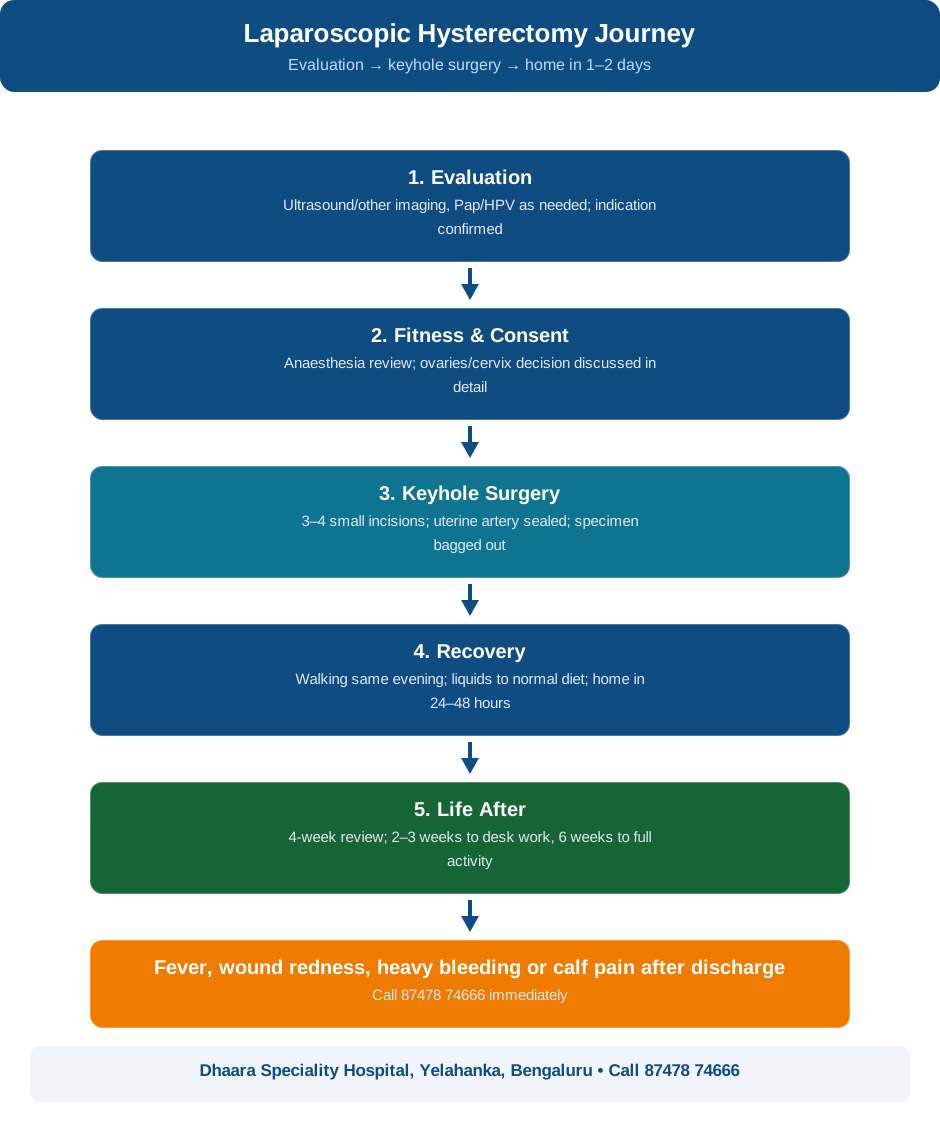
Your Hysterectomy Pathway at Dhaara
What is Laparoscopic Hysterectomy?
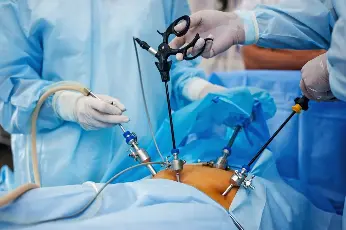
Laparoscopic (keyhole) hysterectomy is a minimally invasive surgical removal of the uterus through small (0.5–1.5 cm) incisions in the abdomen, using a camera and specialised instruments. It offers all the benefits of hysterectomy with significantly less pain, faster recovery, shorter hospital stay, and smaller scars compared to traditional open (abdominal) hysterectomy.
At Dhaara Speciality Hospital, Dr. Prathima Srinivas is an experienced laparoscopic gynaecology surgeon performing Total Laparoscopic Hysterectomy (TLH) and Laparoscopic Assisted Vaginal Hysterectomy (LAVH).
Types of Laparoscopic Hysterectomy
TLH
Total Laparoscopic Hysterectomy — entire procedure done laparoscopically; uterus removed vaginally. Most common technique. Removes uterus and cervix.
LAVH
Laparoscopic Assisted Vaginal Hysterectomy — laparoscopy assists the vaginal portion. Good for larger uteruses or cases with adhesions.
LSH
Laparoscopic Subtotal Hysterectomy — uterus removed, cervix kept. Less commonly done now but preserves cervical ligament support.
Indications: When is Hysterectomy Recommended?
- Uterine fibroids — large, symptomatic, or recurrent after myomectomy; family complete
- Adenomyosis — diffuse uterine thickening causing severe pain and heavy bleeding
- Endometriosis — severe, recurrent disease unresponsive to medical treatment
- Abnormal uterine bleeding — not controlled by medical or hysteroscopic treatment
- Uterine prolapse — uterine descent with associated pelvic floor repair
- Uterine cancer — endometrial cancer, cervical cancer (early stages)
- Ovarian cancer — as part of surgical staging and debulking
- Chronic pelvic pain — unresponsive to other treatments
Lap Hysterectomy vs. Open Hysterectomy
| Feature | Laparoscopic | Open (Abdominal) |
|---|---|---|
| Incision | 3–4 small holes (0.5–1.5 cm) | 10–15 cm abdominal cut |
| Pain level | Mild to moderate | Significant |
| Hospital stay | 1–2 days | 4–5 days |
| Return to activities | 2–3 weeks | 6–8 weeks |
| Blood loss | Minimal | Higher |
| Infection risk | Lower | Higher |
| Cosmesis | Minimal scarring | Visible scar |
The Procedure: What to Expect
- Anaesthesia: General anaesthesia — you are completely asleep
- Duration: 1–3 hours depending on uterine size and complexity
- Gas insufflation: Carbon dioxide gas inflates abdomen; laparoscope inserted through navel
- Dissection: Uterine vessels secured, ligaments divided under direct vision
- Colpotomy: Upper vagina opened laparoscopically; uterus delivered vaginally
- Vault closure: Vaginal cuff closed laparoscopically
- Recovery: 2–4 hours in recovery room; admitted to ward
Recovery After Laparoscopic Hysterectomy
- Day 1–2: Hospital stay; light diet; IV painkillers transitioning to oral; walking encouraged
- Week 1–2: Home rest; light activities only; avoid driving; mild shoulder-tip pain from gas (normal, resolves in 48 hours)
- Week 3–4: Progressive return to normal activities; no heavy lifting (>5 kg)
- 6 weeks: Full recovery; return to work; sexual activity can be resumed after 6–8 weeks (vaginal vault healed)
- No more periods — menstruation permanently stops. If ovaries preserved, no menopause symptoms.
Frequently Asked Questions
Book Your Consultation Today
Dhaara Speciality Hospital, Yelahanka. Same-day appointments available.
Only if the ovaries are removed before natural menopause age. When ovaries are healthy, we preserve them — menopause is avoided and no HRT is needed. This is discussed and decided with you before surgery.
Cervical conservation (subtotal hysterectomy) is an option when Pap/HPV screening is up to date and pathology doesn't require removal. We discuss the pros and cons and respect your preference where medically appropriate.
Far less than open surgery. Most patients need only oral pain relief from day 1–2 and walk to the washroom the same evening. The small port-site discomfort settles within a week.
Desk work in 2–3 weeks, driving once you can brake confidently without pain (~2 weeks), gym/running after 6 weeks, and no lifting heavy weights for 6 weeks to protect the vault healing.
For most women, freedom from chronic bleeding and pain improves intimacy and wellbeing. Libido is driven by ovaries/hormones, which we preserve when possible. Ask us anything at consultation — no question is awkward.
Words From Our Happy Clients
Glowing testimonials from satisfied clients share their positive experiences.
Dhaara Speciality Hospital is a trusted healthcare institution equipped with state-of-the-art facilities and a team of skilled surgeons, including specialists in laparoscopic procedures. Choosing Dhaara for your laparoscopic gallbladder surgery comes with several advantages.
More Reviews
Vinay T
India
Surprised at the excellent facilities
I visited Dhaara Hospital and consulted with Dr. Prathima, a fantastic gynecologist. She's professional, friendly, and listens to my concerns. Her treatment worked well for me, and she always suggests the best.
Suchetha
India
Surprised at the excellent facilities
Dr Sreenivas is brilliant. The way, he listens to the patients issue giving so much time inspite of his busy schedule. I am very happy to have met him for my mom's surgery. Best Gastro surgeon👏👏.

.webp)
.webp)