Contents
If your surgeon has recommended surgery, you may be wondering: will it be laparoscopic (keyhole) or open? And what does that mean for your recovery? Here is a clear, honest comparison — so you can have an informed conversation with your surgeon.
What Is Laparoscopic Surgery?
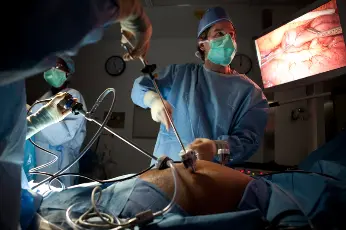
Laparoscopic (or "keyhole") surgery uses 3–4 small cuts (0.5–1.2 cm each). A thin camera (laparoscope) is inserted through one cut, and surgical instruments through the others. The surgeon watches a screen and operates without opening the abdomen.
Open surgery uses a single larger incision (10–25 cm depending on the operation) to directly access the abdomen. The surgeon operates with direct vision.
Head-to-Head Comparison
| Factor | Laparoscopic | Open |
|---|---|---|
| Incision size | 3–4 cuts of 0.5–1.2 cm | 1 cut of 10–25 cm |
| Blood loss | Minimal (50–200 mL typical) | Higher (200–500 mL typical) |
| Post-op pain | Mild – moderate (oral tablets) | Moderate – severe (IV opioids) |
| Hospital stay | Day surgery to 2 nights | 3–7 nights |
| Return to desk work | 7–14 days | 4–6 weeks |
| Full recovery | 3–4 weeks | 6–8 weeks |
| Wound infection risk | <1% | 3–7% |
| Hernia at incision site | Very rare (<0.5%) | 5–15% risk |
| Scarring | Tiny, often near-invisible | Permanent scar |
| Surgeon's vision | Magnified HD camera | Direct but not magnified |
| OT time | Slightly longer (set-up time) | Often quicker for experienced open surgeons |
Recovery Comparison in Practice
Consider two patients having gallbladder removal:
- Patient A — Laparoscopic: Surgery at 9 AM. Home by 6 PM. Mild soreness managed with paracetamol. Back at desk job Day 8. Driving Day 6. Full diet by Week 4.
- Patient B — Open: Surgery at 9 AM. Hospital 4–5 nights. Significant pain, IV morphine for 2–3 days. No driving for 4 weeks. Back to desk job Week 5. Full recovery by Week 8.
Cost Comparison — Laparoscopic vs Open at Dhaara Hospital
| Procedure | Laparoscopic (₹) | Open (₹) | Why the difference? |
|---|---|---|---|
| Cholecystectomy (gallbladder) | 35,000 – 60,000 | 30,000 – 55,000 | Lap has shorter stay, but slightly higher equipment cost |
| Hernia repair | 40,000 – 75,000 | 25,000 – 50,000 | Lap has mesh + specialised instruments, but shorter stay |
| Appendectomy | 30,000 – 55,000 | 25,000 – 45,000 | Similar — lap recovery faster, so total cost often similar |
When accounting for lost income during recovery, laparoscopic surgery is almost always more cost-effective overall despite slightly higher procedure cost.
When Is Open Surgery Still Preferred?
Open surgery remains the right choice in specific situations:
- Advanced cancer: When tumour resection requires wide access that laparoscopy cannot provide safely
- Dense adhesions: Previous multiple abdominal surgeries may have created adhesions that block safe laparoscopic access
- Massive haemorrhage: Emergency bleeding that needs immediate open control
- Surgeon skill set: Not all surgeons are trained in laparoscopic surgery for every procedure — ask your surgeon directly
- Equipment limitation: Some hospitals do not have the required laparoscopic setup for complex procedures
- Patient preference: Rare, but some patients prefer open surgery after discussion
What Is a Laparoscopic Conversion?
Sometimes, a surgery that begins laparoscopically is converted to open during the procedure. This is not a failure — it is the surgeon making the safest decision when they encounter unexpected anatomy, dense adhesions, bleeding, or a finding that requires direct access.
Conversion rate for laparoscopic cholecystectomy at experienced centres: 2–5%. At Dhaara Hospital, it is under 3%.
Before your surgery, ask your surgeon: "What is your conversion rate for this procedure?" A very low rate (under 5%) in a high-volume surgeon indicates experience; a zero rate is sometimes a red flag (it may mean they are converting too late).
How Do You Know Which Surgery You'll Have?
Your surgeon makes this decision based on:
- The specific procedure (most routine procedures are now laparoscopic by default)
- Your imaging findings (CT / MRI / ultrasound)
- Your previous surgical history (prior abdominal surgeries increase adhesion risk)
- Your overall fitness (BMI, cardiac, pulmonary status)
- The surgeon's experience and available equipment
At your pre-surgical consultation at Dhaara Hospital, your surgeon will explain which approach is planned and why — and will answer all your questions before you consent.
Laparoscopic Surgery in North Bangalore
Dhaara Hospital, Yelahanka — gallbladder, hernia, appendix, anti-reflux and more. Serving Hebbal, Vidyaranyapura, Sahakarnagar, Devanahalli.
View All Procedures 📞 87478 74666Frequently Asked Questions
Related: Laparoscopic Surgery at Dhaara | Laparoscopy in North Bangalore | Gallbladder Surgery Recovery Guide